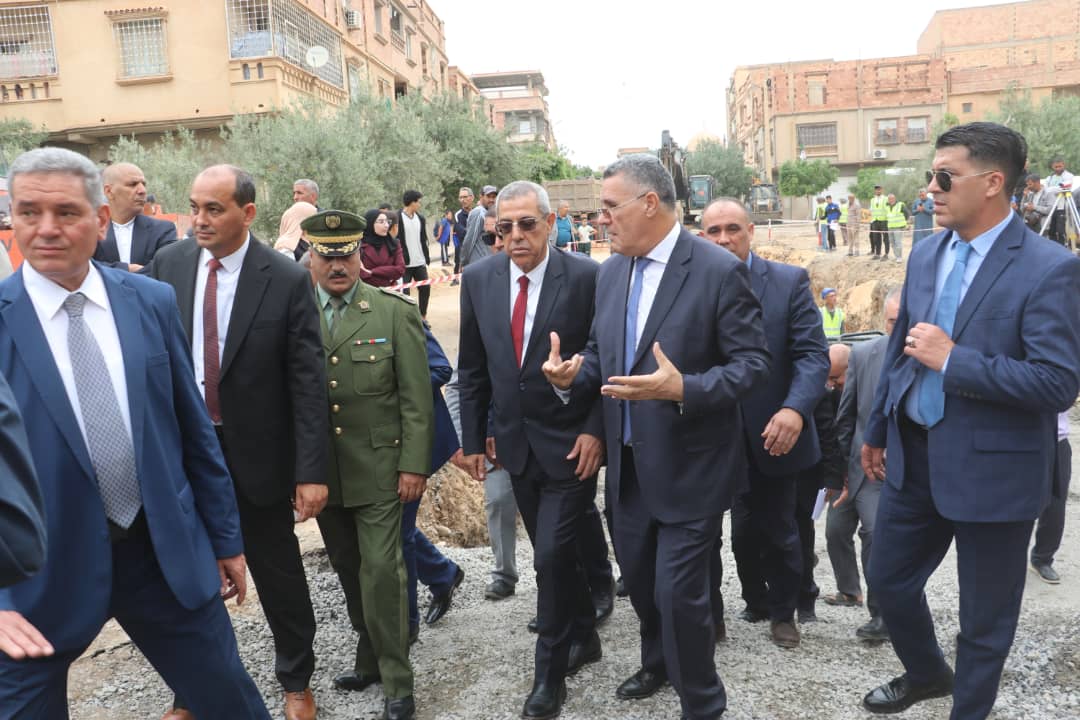
M’sila/ On the evening of Wednesday, 6 May 2026, Mr Nadjm Eddine Tayar, Wali of the Wilaya of M’Sila, received Mr Lounès Bouzegza, Minister of Hydraulics, and the members of his accompanying delegation at the official guest residence at the Wilaya headquarters.
The reception was attended by the President of the Wilaya People’s Assembly, members of the Wilaya Security Commission, members of the National People’s Assembly, the local delegate of the Republic’s Mediator, the Secretary-General of the Wilaya, the Director of Hydraulics, the Director of Civil Protection, the Head of the Daïra of M’Sila, the President of the People’s Communal Assembly of M’Sila, directors of the various executive departments, the Director of the M’Sila unit of the Algerian Water Company, the Director of the M’Sila unit of the National Sanitation Office, and officials from the water resources sector.
Meeting on the State of the Water Resources Sector
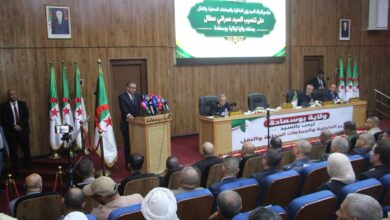
The working and inspection visit of Mr Lounès Bouzegza, Minister of Hydraulics, began on Thursday, 7 May 2026, with a meeting on the state of the sector, held in the Nourddine Sahraoui Meeting Room at the Wilaya headquarters.
The meeting was attended by Mr Nadjm Eddine Tayar, Wali of the Wilaya of M’Sila; the President of the Wilaya People’s Assembly; the Delegated Wali of Bou Saâda; members of the Wilaya Security Commission; members of both chambers of Parliament; the local delegate of the Republic’s Mediator; the Wilaya Inspector General; members of the Supreme Council for Youth; the Director of Hydraulics; the Director of Civil Protection; the Head of the Daïra of M’Sila; the President of the People’s Communal Assembly of M’Sila; directors of the various executive departments; the Director of the M’Sila unit of the Algerian Water Company; the Director of the M’Sila unit of the National Sanitation Office; officials from the water resources sector; and representatives of the media.
Following the recitation of verses from the Holy Quran and the national anthem, the Wali welcomed the Minister of Hydraulics and his accompanying delegation. He then outlined the current state of the water resources sector, highlighting the achievements made, projects approved and projects under implementation, as well as the measures taken to improve public water supply services for residents.
The President of the Wilaya People’s Assembly, for his part, emphasised the urgent need to improve access to drinking water and called for the construction of hill dams and other dams.
The Director of Hydraulics of the Wilaya then delivered a comprehensive presentation on the sector. It covered key sector indicators, various planned, completed and ongoing projects, and future prospects for strengthening water resources and improving public services.
1. Drinking Water Supply: Sources of Supply
A. Groundwater Resources
- The number of operational boreholes used for drinking water supply stands at 498, accounting for 90% of the resources allocated to supplying the population, with a volume of 187,481 m³ per day.
- Number of boreholes managed by the Algerian Water Company: 209.
- Number of boreholes managed by municipalities: 289.
B. Surface Water Resources
The Wilaya receives water from three dams:
- Soubella Dam, in the Wilaya of M’Sila;
- Koudiat Acerdoune Dam, in the Wilaya of Bouira;
- Tilesdit Dam, in the Wilaya of Bouira.
These sources account for 10% of the water allocated to supplying the population with drinking water.
Koudiat Acerdoune Dam – Wilaya of Bouira
This dam supplies six municipalities. The volume allocated to the Wilaya is 15,000 m³ per day, while the actual supply is 13,668 m³ per day, resulting in a shortfall of 1,332 m³ per day.
The beneficiary municipalities and the reported volumes are:
- Aïn El Hadjel: 3,455 m³;
- Sidi Hadjerès: 415 m³;
- Sidi Aïssa: 5,667 m³;
- Bouti Sayeh: 442 m³;
- Bou Saâda: 3,689 m³.
Tilesdit Dam – Wilaya of Bouira
This dam supplies the municipalities of Hammam Dhalâa and Ouannougha. The volume allocated to the Wilaya is 4,000 m³ per day, while the actual supply is 3,643 m³ per day, resulting in a shortfall of 357 m³ per day.
The volumes supplied to the beneficiary municipalities are:
- Hammam Dhalâa: 929 m³;
- Ouannougha: 2,714 m³.
Soubella Dam
This dam supplies the municipalities of Magra and Berhoum. Its storage capacity is estimated at 17 million m³, while its production capacity is 4,200 m³ per day.
Current production stands at 2,800 m³ per day, distributed as follows:
- Magra: 800 m³ per day;
- Berhoum: 2,000 m³ per day.
The facility is currently undergoing maintenance by the relevant services, pending the delivery, installation and commissioning of the new treatment plant, which will have a maximum production capacity of 4,200 m³ per day.
2. Management and Operational Indicators
- Number of municipalities managed by the Algerian Water Company: 21.
- Number of municipalities managed by municipal services: 26.
- Total length of the drinking water supply network across the Wilaya: 5,393 km.
- Number of water reservoirs: 520, with a total storage capacity estimated at 275,408 m³.
- Average network connection rate: 93%.
3. Current Production
The water production system includes 498 operational boreholes, with total production estimated at 202,143 m³ per day, comprising:
- 187,481 m³ per day from groundwater resources;
- 14,662 m³ per day from surface water resources.
4. Drinking Water Distribution Programme Across the Wilaya’s Municipalities
Distribution Frequency Across the Population
- 1% of the population receives a continuous daily water supply, 24 hours a day, representing approximately 13,479 residents.
- 6% of the population receives water for 4 hours each day, representing approximately 80,575 residents.
- 48% of the population receives water according to a schedule ranging from half a day to one-fifth of a day, with an average distribution duration of 4.02 hours per day, representing approximately 646,997 residents.
- 45% of the population receives water according to a schedule ranging from one-sixth to one-nineteenth of a day, with an average distribution duration of 4.02 hours per day, representing approximately 606,559 residents.
5. Projects to Improve Drinking Water Supply
As part of the daily monitoring of residents’ drinking water needs, and with the aim of improving the regularity and continuity of water supply, the Wilaya of M’Sila benefited from a programme covering the period 2023–2026, involving the drilling of 89 boreholes with an allocated budget of DZD 3.431 billion (343.1 billion centimes).
Summary of the Physical Progress of Borehole Projects
Of the 89 planned boreholes, with a total budget of 343.1 billion centimes:
- 33 boreholes have been commissioned;
- 6 boreholes have been completed;
- 32 boreholes are under construction;
- 14 boreholes are undergoing administrative procedures, including projects registered for 2026;
- 4 boreholes yielded negative results. New drilling locations have been selected for two of these, while the contracts for the other two have been terminated.
Status of the Four Boreholes in the Municipality of Aïn El Melh
The four boreholes have reached a completion rate of 100%, with a combined flow rate estimated at 50 litres per second. They have also been connected to the electricity network, pending the installation of equipment scheduled for the coming days.
The connection of the four boreholes to the reservoir has reached 70% completion, over a total network length estimated at 8 km.
Transferring water from the planned reservoir requires the construction of a main pipeline over a distance of 23 km. To date, 8 km of pipelines have been laid. Completing an additional 5 km will make it possible to provide drinking water to residents of Aïn El Melh as an emergency measure, pending completion of the remaining section at a later stage.
Completed Boreholes Awaiting Connection
Administrative procedures are under way to complete pipeline and electricity connections for the six completed boreholes whose connection works remain outstanding.
6. Proposals
The proposals put forward include the following:
- Increase the water allocation for the Wilaya, with the proposal referring to a volume of 47,000 m³ per day instead of the 15,000 m³ per day currently mentioned, in order to eliminate the recorded shortfall and improve drinking water supply.
- Conduct a geophysical survey in the municipality of Souamaa to establish a new water abstraction field and identify additional water resources.
- Conduct a geophysical survey across the entire Wilaya to identify aquifer layers and assess available groundwater reserves in the various municipalities.
Remarks and Directives of the Minister of Hydraulics
The Minister expressed his satisfaction and appreciation at visiting the Wilaya, noting that the visit was part of the directives of the President of the Republic. He reviewed the sector’s indicators, the various approved, completed and ongoing projects, and the prospects for strengthening water resources and improving public services.
The Minister commended the efforts made and the continuous improvements in drinking water supply. He also highlighted the Wilaya’s available resources and the diversity of its water sources, calling for their optimal use, sound management, effective field operations and the rationalisation of water consumption.
He emphasised the ambitious programme allocated to the Wilaya, which is expected to progressively meet its needs for this vital resource and contribute to achieving water security.
Finally, the Minister issued a series of practical directives aimed at improving water supply, including accelerating project implementation and taking immediate action to address leaks and illegal connections. He stressed the importance of prioritising needs when determining the measures to be implemented.